
Ολύμποι
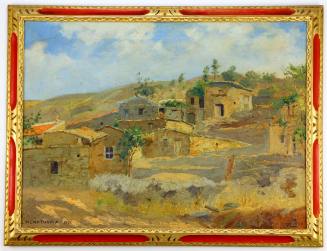
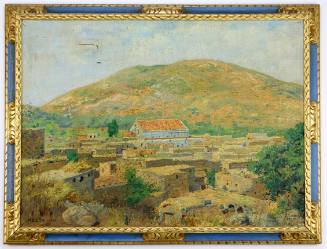
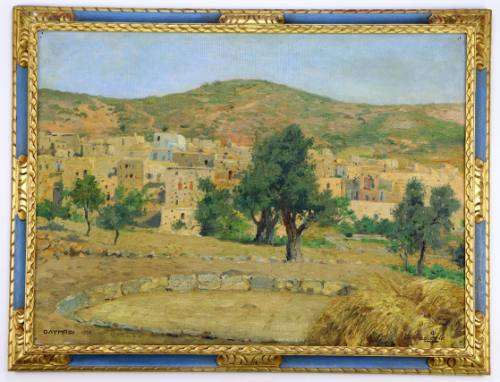
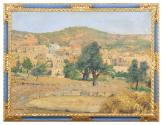
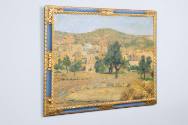
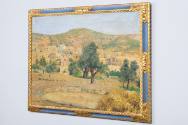
004626 Frixos Aristefs, Olympi, 1936, oil on canvas, 50 × 66 cm
A careful reader of Aristefs’ Autobiography will notice that the paintings of Chios were executed within a short time, limited by the painter’s need to move quickly from one village to another. “Within three hours, I completed the general view of the village of Olympi, with a threshing floor in the foreground where bundles were laid out for threshing,” he recalled. Indeed, the composition opens with a pile of sheaves in the lower right corner, giving way to the circular threshing floor. A few scattered trees indicate that the painter stands outside the village boundaries, which occupy the middle zone of the composition. A dense cluster of houses forms the compact construction, painted in warm tones and almost camouflaged within the dry landscape. Olymbi is a medieval fortified village, like Pyrgi and Elata. Aristefs, however, seems to have disregarded the architectural distinctiveness of Olymbi. Instead, he chose a more suitable, general view of the relatively flat terrain. The swift sketching and the impasto brushstrokes confirm the speed of execution. At the same time, they reveal that Aristefs was a skilled plein-air painter, following the teachings of Impressionism.